
Welcome to the homepage of the lecture
Correspondence Problems in Computer Vision
Summer Term 2014
Home
About Us
People
Teaching
Research
Publications
Awards
Links
Contact
Internal
Correspondence Problems in Computer Vision
Computer Science Teaching Award (summer term 2008)
Instructor:
Oliver Demetz
Office hours: Thu 15-16 c.t.
Examiner:
Prof. Dr. Joachim Weickert
Summer Term 2014
Lectures (2h) with programming/theoretical exercises (2h)
(6 credit points)
This course takes place every
Monday, 14-16 c.t., Building E1.3, HS 001 and
Thursday, 16-18 c.t., either in Building E1.3, HS001 (theory) or CIP-R 104
(programming)
Usually, we will have a lecture every Monday and a tutorial each Thursday.
The first exam will take place on Tuesday, July 29th, 10-12 s.t., and the second one will be on Friday, September 12th, 10-12 s.t..
Synopsis – Prerequisites – Registration – Assignments and Turorials – Schedule – Self-Test Problems – Exams – References
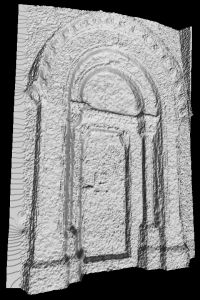
Example - Stereo Reconstruction
 |
 |
 |
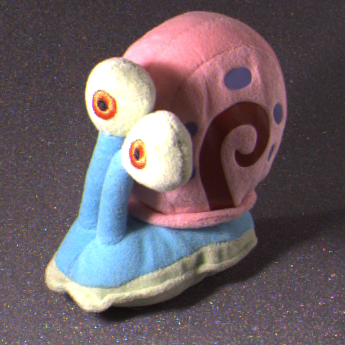
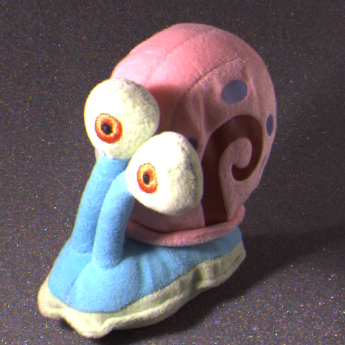
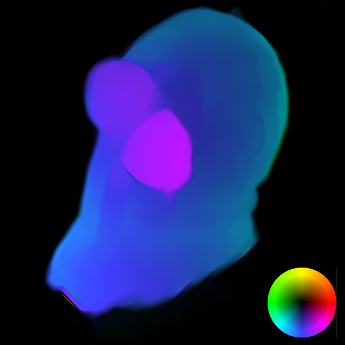
Example - Motion Estimation
 |
 |
 |
Correspondence problems are a central topic in computer vision. The basic
task amounts to identifying and matching corresponding
features in different images/views of the same scene. Typical examples for
correspondence problems are (i) the estimation of motion information from
consecutive frames of an image sequence (optic flow), (ii) the reconstruction
of a 3-D scene from a stereo image pair and (iii) the registration of medical
image data from different image acquisition devices (e.g. CT and MRT).
The central part of this lecture is concerned with discussing the most important
correspondence problems together with suitable algorithms for their
solution.
This class is particularly useful for those students who wish to
to pursue a master thesis in our group in the field of computer vision.
Suited for students of visual computing, applied mathematics and computer science. Requires undergraduate knowledge in mathematics (e.g. ''Mathematik für Informatiker I-III'') and elementary C knowledge (for the programming assignments). Knowledge in image processing or differential equations is useful. The lectures will be given in English.
In order to participate in the lecture/exam you have to register twice:
- Firstly, you have to register online to the system of the MIA group. This gives us an estimate of the number of students attending the course and allows us to issue the certificates at the end of the semester. The registration period is over.
- Secondly, depending on your field of study, you have to register online for the lecture/exam to the general system of Saarland University: the HISPOS system.
Our weekly tutorials alternate between programming and theory. They take place in:
Building E1.3, HS 001 (theory)
CIP-R 104 (programming)
As part of the tutorials, assignments are offered.
Both, programming and theoretical assignments
will be solved and discussed in the tutorials.
Working in groups of up to 3 people is permitted.
The only requirement for the admission to the exam is
the regular attendance of the tutorials. You will not
be allowed to take part in the exam if you miss more than two tutorials.
Please note that some theoretical tutorials have to be scheduled to Mondays.
Both, the source code needed for the programming assignments as well as example solutions for all the assignments will be provided on this page during the semester.
Course material will be made available on this webpage in order to
support the classroom teaching and the tutorials, not to replace
them. Additional organisational information, examples and explanations
that may be relevant for your understanding and the exam are provided
in the lectures and tutorials. It is solely your responsibility
- not ours - to make sure that you receive this information.
The following table shows a preliminary list of topics that will be
covered during the semester.
| Date | Topic | Material |
|---|---|---|
| 17/04 |
Lecture 1: Introduction, Overview |
[slides] |
| 24/04 |
Lecture 2: Block Matching, Correlation Methods, Occlusion Detection, Interest Points, Feature Methods + Programming Assigment 1 (P1) |
[slides] |
| 28/04 |
Lecture 3: Optic Flow I: Local Differential Methods, Parametrisation Models + Theoretical Assigment 1 (T1) |
[slides] |
| 01/05 | Public holiday | |
| 05/05 |
Lecture 4: Optic Flow II: Global Differential Methods, Horn and Schunck + Programming Assigment 2 (P2) |
[slides] |
| 08/05 | Tutorial P1: Blockmatching |
[assignment] [solution] |
| 12/05 | Tutorial T1: Sub-Pixel Refinement, Taylor Linearisation, Minimization of the Lucas/Kanade Method | [solution] |
| 15/05 | Tutorial P2: Horn and Schunck Method | [assignment] |
| 19/05 |
Lecture 5: Optic Flow III: Advanced Constancy Assumptions, Large Motion + Theoretical Assigment 2 (T2) |
[slides] |
| 22/05 | Tutorial T2: Motion Tensor Notation, Affine Horn and Schunck, Photometric Invariants | [solution] |
| 26/05 |
Lecture 6: Optic Flow IV: Advanced Data and Smoothness Terms + Programming Assigment 3 (P3) |
[slides] |
| 29/05 | Public holiday | |
| 02/06 |
Lecture 7: Optic Flow V: High Accuracy Methods + Theoretical Assigment 3 (T3) |
[slides] |
| 05/06 | Tutorial P3: Gradient Constancy and Backward Registration | [assignment] |
| 09/06 | Public holiday | |
| 12/06 | Tutorial T3: Dataterm Robustification, Gauss-Seidel with Warping | [solution] |
| 16/06 |
Lecture 8: Optic Flow VI: Advanced Numerics + Theoretical Assigment 4 (T4) |
[slides] |
| 19/06 | Public holiday | |
| 23/06 |
Lecture 9: Stereo Matching I: Projective and Epipolar Geometry + Programming Assigment 4 (P4) |
[slides] |
| 26/06 | Tutorial T4: Smoothness Terms | [solution] |
| 30/06 |
Lecture 10: Optic Flow + Stereo: Scene Flow Estimation |
[slides] |
| 03/07 | Tutorial P4: Coarse-to-Fine Warping | [assignment] |
| 07/07 |
Lecture 11: Medical Image Registration: Mutual Information, Elastic and Curvature Based Registration, Landmarks + Theoretical Assigment 6 (T6) |
[slides] |
| 10/07 | Tutorial T6: Variational Optic Flow with Epipolar Term | [solution] |
| 14/07 |
Lecture 12: Particle Image Velocimetry: Div-Curl-Regularisation, Incompressible Navier Stokes Prior + Programming Assigment 6 (P6) |
[slides] |
| 17/07 | Tutorial P6: Mutal Information | [assignment] |
| 21/07 |
Lecture 13: Summary, Outlook |
The followning problems should resemble a typical exam. You will have 2 hours (120
minutes) time to solve them without using the lecture notes or other auxiliary
material. You can achieve 30 p. in total, so you have 4 minutes per point.
| Self-Test Problems | Self-Test Problems - Solutions |
There will be closed book, written exams.
The first exam will take place on Tuesday, July 29th, 10-12, Building E1.3 HS 002.
The second exam will be held on Friday, September 12th, 10-12, Building E2.5 (Maths building!) HS II.
In order to qualify for the exams attendance of the tutorials is mandatory.
You will not be allowed to take part in the exam if you miss more than two
tutorials. In case of qualification, you are allowed to take part in
both exams. The better grade counts.
There is no specific book that covers the complete content of this class. Many lectures will be based on articles from journals and conferences. However, the following three books cover most topics:
- Optic Flow
A. Bruhn: Variational Optic Flow Computation: Accurate Modeling and Efficient Numerics.
Ph.D. Thesis, 2006. Available from /bruhn/PhDThesis.pdf
- Stereo Reconstruction
L. Valgaerts: Variational 3D Reconstruction from Stereo Image Pairs and Stereo Sequences
Ph.D. Thesis, 2011. Available from http://www.mpi-inf.mpg.de/~valgaerts/pubs/valgaerts_phdthesis.pdf
- Medical Image Registration
J. Modersitzki: Numerical Methods for Image Registration. Oxford Press, 2003.
MIA Group
©2001-2023
The author is not
responsible for
the content of
external pages.
Imprint -
Data protection